
About the board
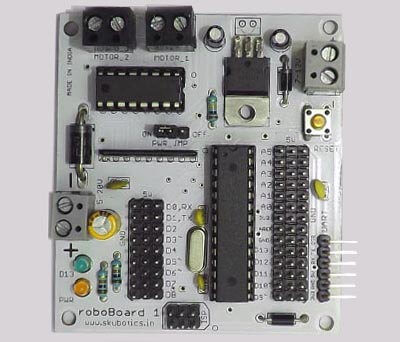
RoboBoard is the latest Arduino-compatible robot board by Skubotics, replacing the earlier Tduino boards. It saves you the effort of building different circuits and hasty connections to build a robot - instead, plug in motors and sensors and start feeding logic straight away.
We’ve manufactured 1,000+ units and are upgrading to v3.0 to support the #AtmanirbharBharat idea.
Need a custom robotics or product build? Our product design team takes it from schematic to manufacture, or browse our full hardware lineup.
Technical specifications
- Atmega 8/168/328 µC supported
- Off-board USB Serial Uploader
- Recommended input: 7.5V – 12V DC (via adapter)
- Digital I/O pins: 14
- Analog input pins: 6
- Clock speed: 16 MHz
- Motor drivers: L293D, SN7544
- Board dimensions: 74mm × 66mm
Features
- Every GPIO paired with 5V & GND pins
- Screw terminals for motors & battery
- Isolated motor and board power
- Bi-directional control of two motors
- Off-board USB Serial Uploader (USB2Serial)
- ICSP header present
Pairs well with.
USB2Serial
The off-board sketch uploader for RoboBoard.
// kitArduino Robot Kit
RoboBoard + sensors - build 7 robots.
// essentialBarebone
Cost-effective Arduino-compatible board.
Ordering for a lab or workshop?
Bulk pricing available for institutions.
RoboBoard, answered.
The board itself, supporting Atmega 8/168/328, with dual bi-directional motor drivers (L293D / SN7544), screw terminals for motors and battery, an ICSP header, and an off-board USB Serial uploader - you'll need a USB2Serial adapter to flash sketches.
Yes - it saves you the effort of wiring a separate motor driver circuit. Just plug in motors and sensors and start feeding logic, and it's compatible with the Arduino IDE.
Any two-motor robot - our Arduino Robot Kit is built around RoboBoard and covers seven robot builds, from line following to Bluetooth and voice control.
A standard Arduino needs an external motor driver shield wired in separately. RoboBoard builds dual bi-directional motor drivers and isolated motor/board power directly onto the board, while staying compatible with the Arduino IDE.